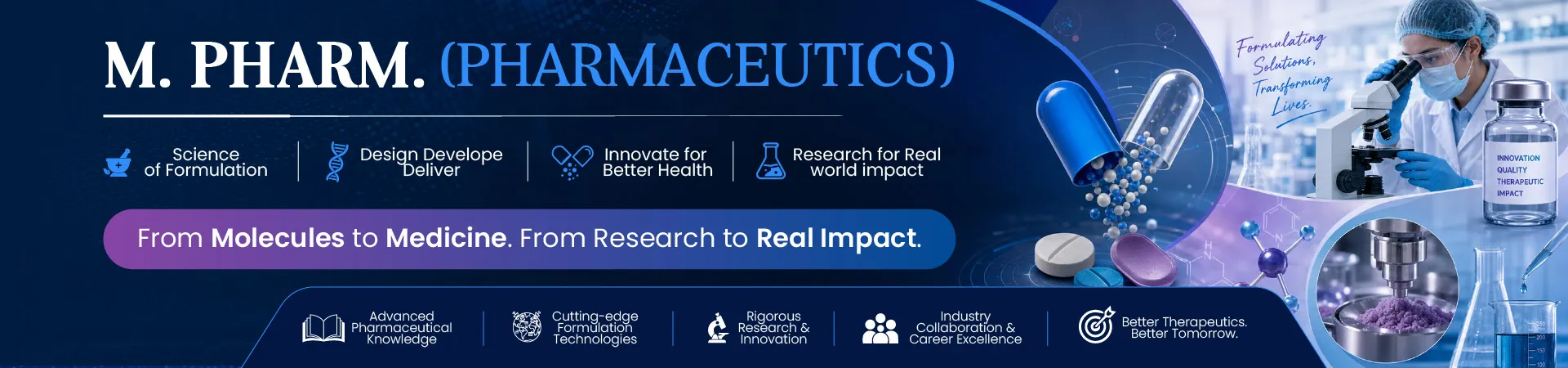
M.PHARM. – Pharmaceutics (2 Year Program)
The Master of Pharmacy (M.Pharm.) in Pharmaceutics is a two-year postgraduate program that focuses on the science and technology of drug formulation, development, manufacturing, and delivery systems.
The course provides advanced knowledge in pharmaceutical product development, novel drug delivery systems, quality assurance, and industrial pharmacy through a combination of theoretical learning and research. It equips students with the technical and analytical skills required to meet the evolving demands of the pharmaceutical industry. Students aspiring to build expertise in pharmaceutical innovation, research, and advanced drug delivery technologies will find M.Pharm. (Pharmaceutics) an excellent choice for career growth and specialization.
Eligibility
The candidate must have passed Bachelor in Pharmacy (B.Pharm.) from a Pharmacy Council of India (PCI)-approved institution recognized by the respective statutory authorities.
Applicants should have secured a minimum of 55% aggregate marks in the qualifying examination (aggregate of four years of B.Pharm.)
Graduate Pharmacy Aptitude Test (GPAT) passed candidates are given preference over other candidates.
Intake
Total number of seats: 15
Admissions Process
M. Pharm.
Through Common University Entrance Test (CUET)

Register yourself for CUET (UG) 2026

Download Admit Card and Appear
for CUET (UG) Exam

Select “Lloyd Institute of Management
and
Technology” Institute Code: 172
in CUET Counseling
Through Direct Admission
How to Apply Direct Admission?
The direct admission process is very easy. Follow the steps mentioned below:

Fill the application form

The selected candidates will
be called for
interview
(online / offline mode)

Admission offer letter will
be sent to the
selected
candidates

Acceptance of offer letter
and payment of the
INR 25000 (1st installment)
Approval
M.Pharm. – Pharmaceutics course at Lloyd is approved by Pharmacy Council of India (PCI).
Scope
Graduates can pursue careers in:
- Formulation Research & Development (R&D): Development and optimization of novel drug formulations and advanced drug delivery systems.
- Pharmaceutical Manufacturing: Production, process development, technology transfer, scale-up, and industrial pharmacy operations.
- Quality Control (QC) & Quality Assurance (QA): Quality testing, validation, regulatory compliance, and quality management in pharmaceutical manufacturing.
- Drug Delivery & Product Development: Design and evaluation of oral, topical, injectable, and novel drug delivery systems.
- Regulatory Affairs: Preparation of regulatory dossiers and ensuring compliance with national and international pharmaceutical regulations.
- Production & Manufacturing: Supervise pharmaceutical manufacturing processes and improve production efficiency.
- Clinical Research: Support clinical trials and pharmaceutical product development.
- Academia & Research: Teaching and research opportunities in pharmacy colleges, universities, and research organizations.
- Higher Studies: Pursuing a Ph.D., postdoctoral research, or specialized training in pharmaceutics, pharmaceutical technology, nanotechnology, or related pharmaceutical sciences.