Faculty Development Program (FDP)-1.0 on "Empowering Educators with Python & AI"
Photo Gallery
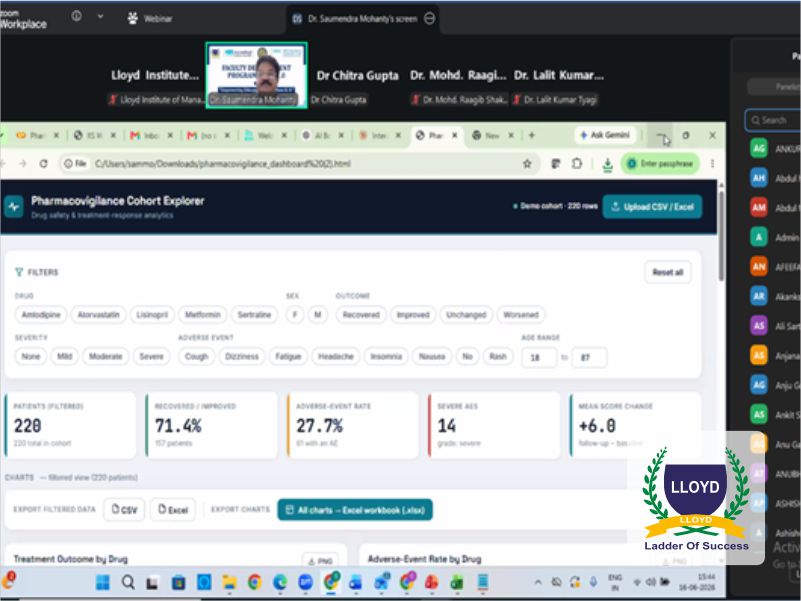
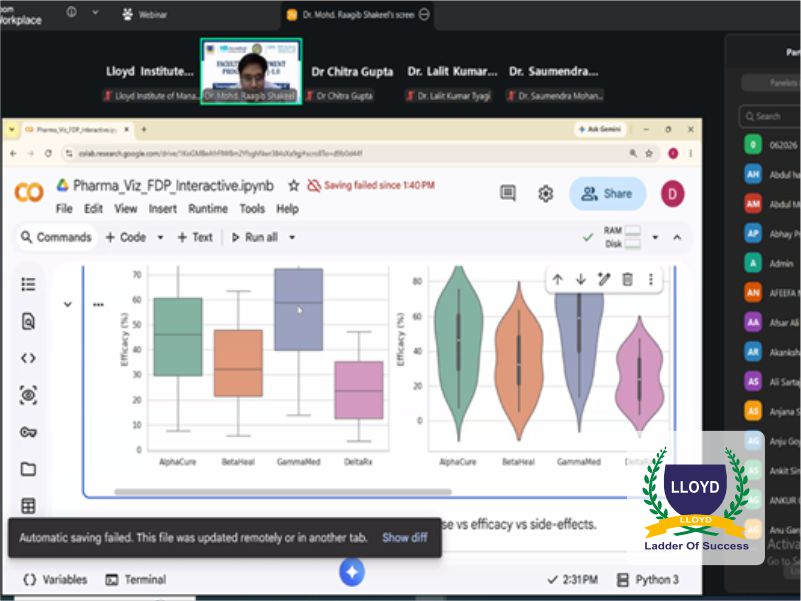
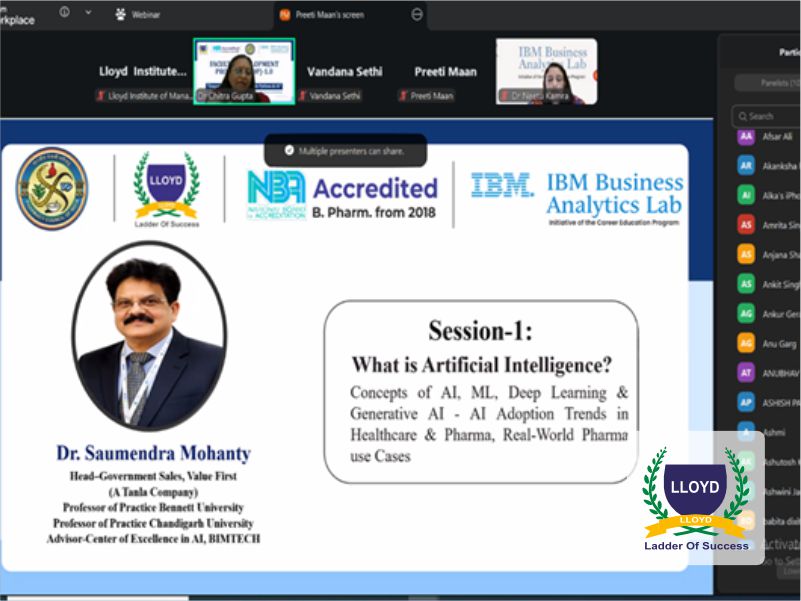
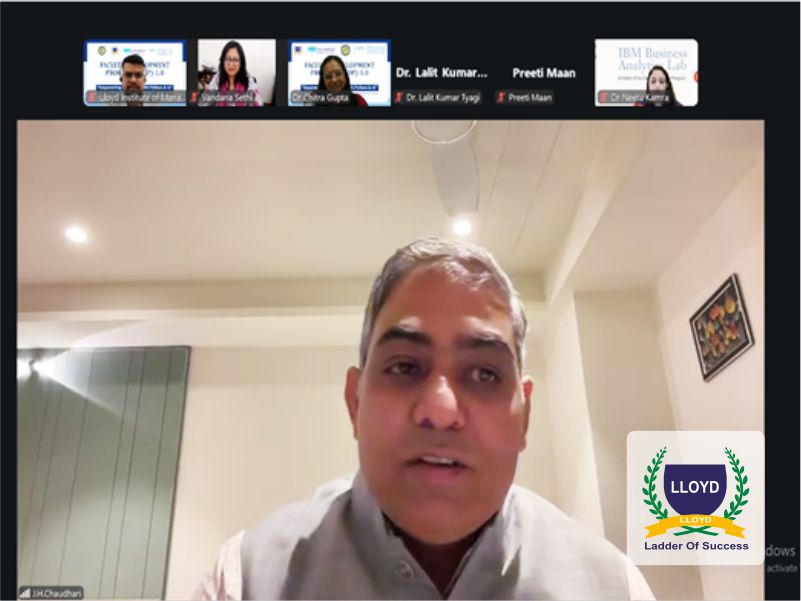
| Event Name: Faculty Development Program (FDP)-1.0 on "Empowering Educators with Python & AI" (Capacity Building of Pharmacy Educators to Cater to the New Pharmacy Curriculum) | Event Date: 15th–19th June, 2026 |
| In Collaboration with: Pharmacy Council of India (PCI) & IBM Business Analytics Lab | Chief Guest: Mr. Jashubhai Hirabhai Chaudhari, Vice-President, Pharmacy Council of India (PCI), Ministry of Health & Family Welfare, Government of India |
| Duration: Five Days | Organized by: Department of Pharmacy, Lloyd Group of Institutions, Greater Noida |
The Department of Pharmacy, Lloyd Group of Institutions, Greater Noida, successfully organized a five-day Faculty Development Program (FDP)-1.0 on “Empowering Educators with Python & AI” from 15th to 19th June 2026 in collaboration with the Pharmacy Council of India (PCI) and IBM Business Analytics Lab. The FDP was conceptualized as a capacity-building initiative to equip pharmacy educators with emerging technological competencies in Artificial Intelligence (AI), Python programming, and data analytics, enabling effective implementation of the revised Pharmacy curriculum aligned with NEP-2020 and the Pharmacy Council of India (PCI).
Inaugural Session:
The program commenced with an Inaugural Session, graced by Mr. Jashubhai Hirabhai Chaudhari, Vice-President, Pharmacy Council of India (PCI), Ministry of Health & Family Welfare, Government of India, as the Chief Guest. The welcome address was delivered by Dr. Chitra Gupta, Professor & Dean-PG, Department of Pharmacy, Lloyd Group of Institutions, while Prof. Vandana Arora Sethi, Chief Strategy Officer & Head of Growth, Lloyd Group of Institutions, addressed the participants and highlighted the growing significance of Artificial Intelligence and digital technologies in transforming pharmacy education and healthcare practices. The inaugural session set the tone for the intensive learning experience by emphasizing the need for continuous faculty upskilling in accordance with evolving industry and academic expectations.
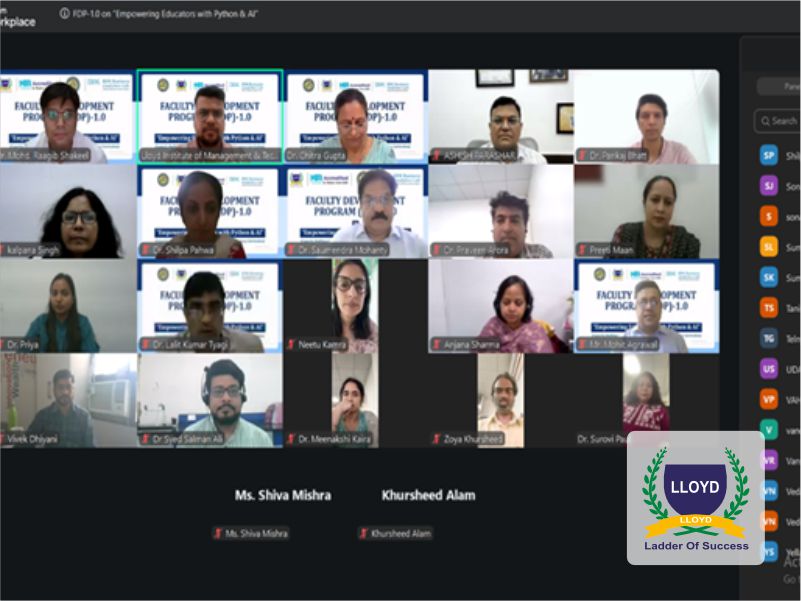
The FDP witnessed enthusiastic participation from faculty members, academic administrators, research scholars, and industry professionals representing pharmacy institutions from different parts of the country. Throughout the five-day program, participants attended a series of expert lectures, hands-on demonstrations, practical coding sessions, case studies, and project-based learning activities conducted by renowned academicians and AI practitioners.
Day-wise Highlights:
Day 1: Introduced participants to the fundamentals of Artificial Intelligence, Machine Learning, Deep Learning, and Generative AI, followed by discussions on AI adoption in pharmaceutical research, drug discovery, clinical trials, and regulatory compliance. Participants were also guided through Python environment setup using Anaconda, Jupyter Notebook, and Google Colab, enabling them to begin hands-on programming in Python.
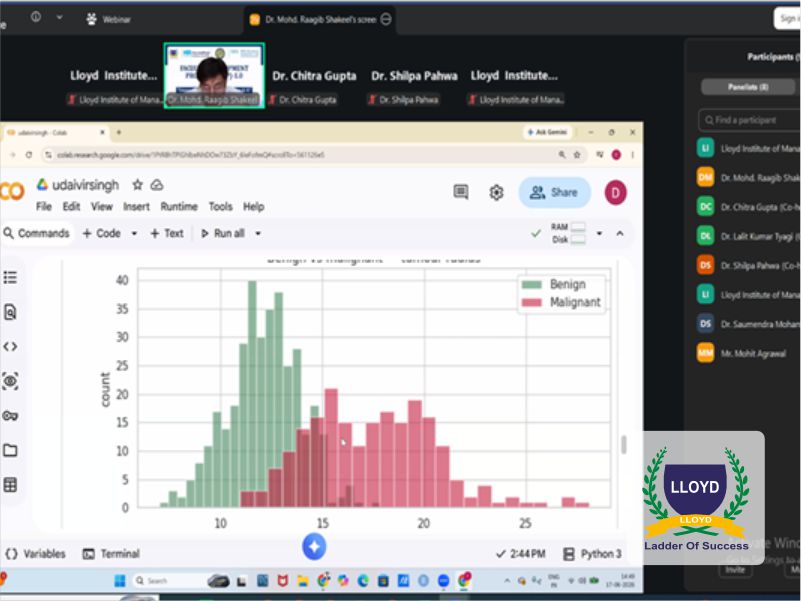
Day 2: Participants explored data visualization techniques using Matplotlib, Seaborn, Plotly, and Dash, learning to create interactive dashboards and publication-quality charts for pharmaceutical datasets. The sessions also focused on statistical analysis using Python, including descriptive statistics, hypothesis testing, correlation analysis, regression models, and their practical applications in pharmaceutical sciences.
Day 3: Dedicated to pharmaceutical data analytics using NumPy and Pandas. Participants learned data loading, profiling, cleaning, handling missing values, merging datasets, and feature engineering techniques essential for machine learning applications. Practical demonstrations enabled participants to work with real-world healthcare datasets and understand data preprocessing workflows.
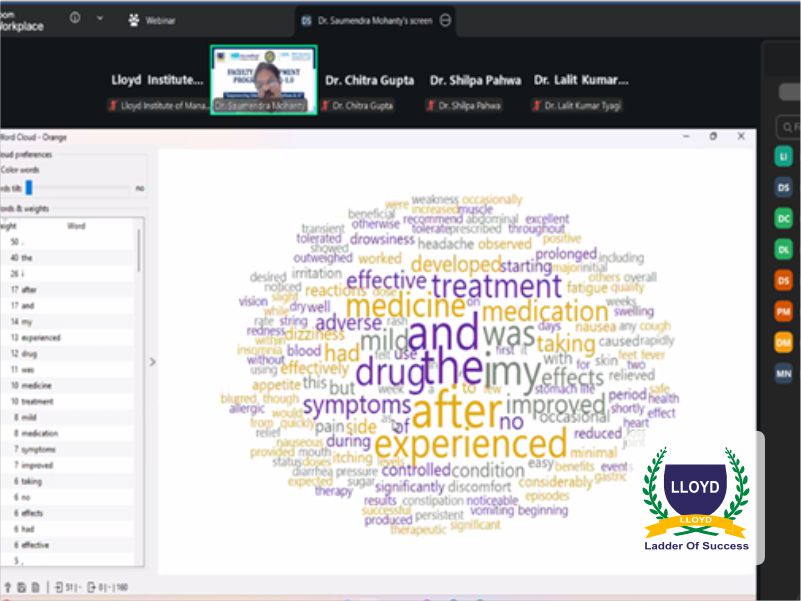
Day 4: Focused on advanced AI applications in pharmacy, including Natural Language Processing (NLP) for Pharmacovigilance, Computer Vision in Pathology and Medical Imaging, AI-driven Drug Discovery, and effective utilization of Generative AI platforms such as Claude and Gemini for literature review, prompt engineering, research assistance, and pharmaceutical intelligence. These sessions provided participants with valuable insights into contemporary AI tools that can significantly enhance research productivity and academic delivery.
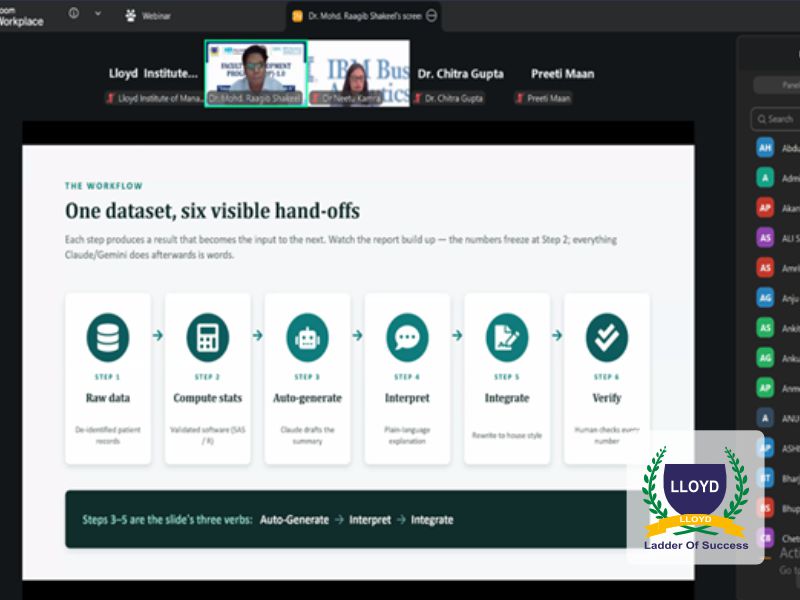
Day 5: Featured automated statistical reporting using Generative AI, followed by the live demonstration of three capstone projects, namely Medication Adherence Tracker, Remote Patient Monitoring Dashboard, and AI-Powered Statistical Report Generator. These projects demonstrated practical implementation of Python and AI concepts in solving real-world healthcare and pharmaceutical problems. The program concluded with an online assessment, participant feedback session, and a valedictory ceremony recognizing the active participation and successful completion of the FDP.
Resource Persons:
The program featured distinguished resource persons including Dr. Neetu Bali Kamra, Dr. Mohd. Raagib Shakeel, Prof. Mohit Agrawal, Prof. Neha Issar, and Dr. Khalid Raza, who shared their expertise across various domains of Artificial Intelligence, Data Science, Business Analytics, Machine Learning, Bioinformatics, Healthcare Analytics, and Python Programming. Their practical demonstrations and interactive sessions significantly enhanced the learning experience of the participants.
Outcomes:
The FDP successfully achieved its objectives of strengthening faculty competencies in Artificial Intelligence, Python programming, data analytics, and digital pedagogy. Participants developed a comprehensive understanding of AI concepts, statistical computing, data visualization, pharmaceutical applications of machine learning, and the integration of Generative AI into teaching, research, and healthcare. The interactive nature of the sessions, combined with practical assignments and project demonstrations, ensured effective knowledge transfer and skill development.
Conclusion:
FDP-1.0 on “Empowering Educators with Python & AI” was a resounding success. It served as an important initiative towards preparing pharmacy educators for the successful implementation of the new PCI curriculum, fostering innovation in teaching-learning methodologies, promoting technology-enabled education, and strengthening research capabilities in pharmaceutical sciences. The Department of Pharmacy, Lloyd Group of Institutions, remains committed to organizing similar capacity-building programs to empower educators with emerging digital technologies and contribute towards excellence in pharmacy education.